End-to-End Nanofiber Capabilities: Development, Manufacturing, and Testing Platform Under One Roof

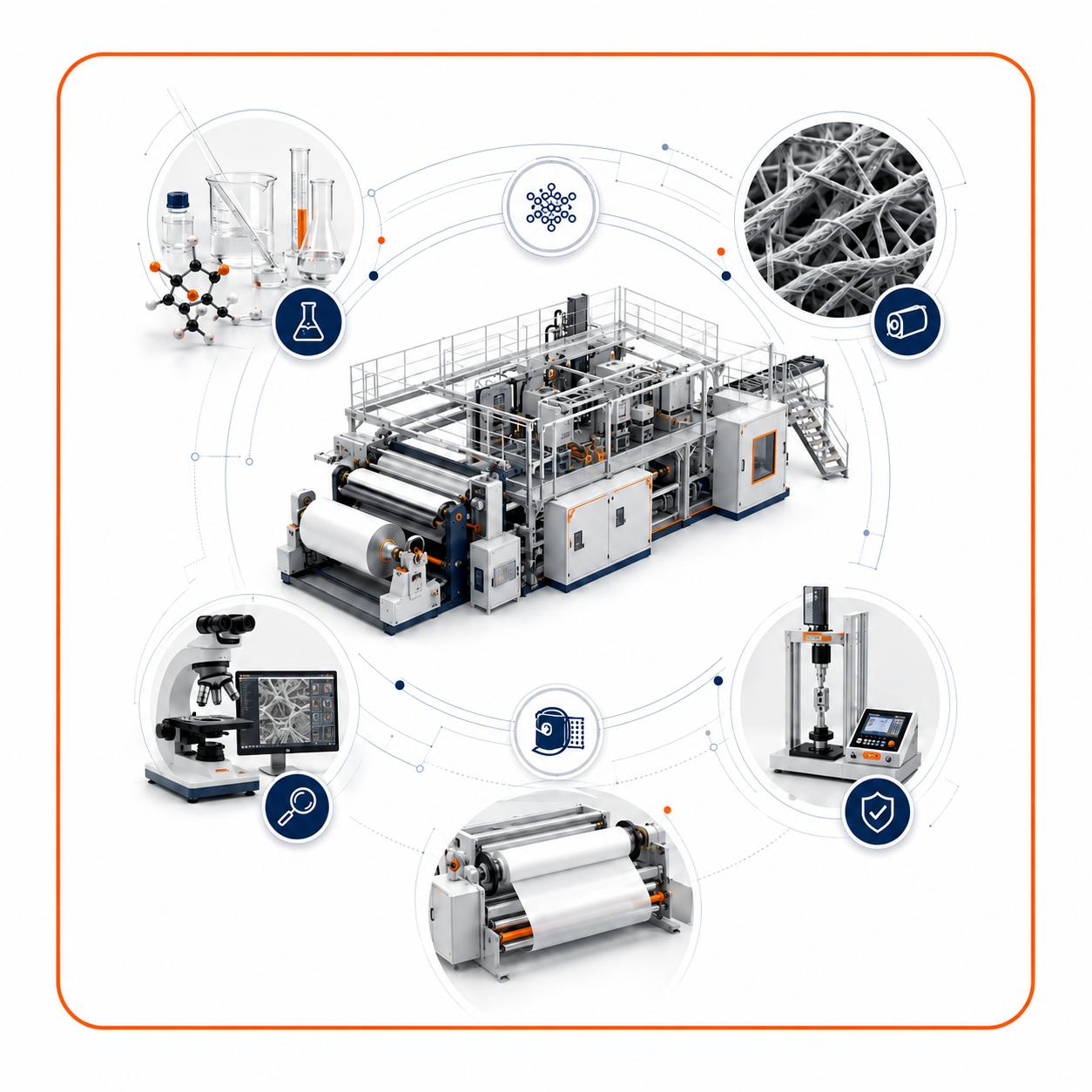
Nexture brings nanofiber development, manufacturing, finishing, converting, and testing into one integrated facility. From chemistry and formulation to industrial nanofiber production, the material can move through lamination, slitting, heat pre-treatment, functional finishing, corrugation, calendering, and precision cutting before being validated through in-house microscopy, filtration testing, porometry, and cosmetic or technical-textile characterization. This integrated platform helps customer programs move faster, protects technical know-how, reduces external dependencies, and keeps control from first formulation through commercial production.

From formulation to finished product

Eight dedicated production and finishing lines

Our manufacturing platform is designed to support both roll-good media and finished or semi-finished product formats. The value is not only the number of machines, but the way the lines work together. Nanofiber production can move directly into substrate integration, finishing, converting, verification, and packaging without breaking the technical chain.

Laboratory and characterization infrastructure

Nanofiber production cannot be managed reliably without the ability to see, measure, and test the structure. Nexture’s laboratory platform combines microscopy, filtration qualification, pore analysis, chemistry, and technical-textile testing. This allows development and quality teams to connect a process adjustment directly to the resulting material structure and application performance.

Phenom XL Scanning Electron Microscope

High-resolution imaging supports nanofiber diameter measurement, morphology review, layer-uniformity analysis, and production quality control. Automated fiber-analysis software and elemental-analysis capability strengthen root-cause investigation and material verification.

Palas MFP Nano Plus

Supports HEPA and ULPA media development through fractional-efficiency and pressure-drop testing aligned with EN 1822 and ISO 29463 methodologies, including evaluation around the most penetrating particle-size region.

Palas MFP 3000

Supports ventilation-filter media characterization and classification work associated with ISO 16890, ASHRAE 52.2, and legacy EN 779 methods. It is used to evaluate efficiency, pressure drop, and media behavior under defined test conditions.

Topas Porometer

Capillary-flow porometry provides mean-flow pore size, bubble point, and pore-size distribution data. This is essential for connecting nanofiber architecture and substrate structure with permeability, barrier behavior, and filtration performance.

VDI 3926 Test Rig

A dedicated pulse-cleaning platform supports development and qualification of cleanable dust-collector media. It helps evaluate pressure-drop evolution, dust loading, cleaning response, residual behavior, and durability over repeated cycles.

Three Specialized Laboratories

Organic chemistry supports polymer and formulation work; physical chemistry evaluates viscosity, rheology, conductivity, surface tension, and process behavior; the technical-textile laboratory supports mechanical, permeability, hydrostatic, basis-weight, and laminate-bond testing.

Two nanofiber manufacturing routes

Free-Surface Solution Electrospinning

Our solution-electrospinning route supports a broad range of polymers, formulations, additives, and functional ingredients. It is selected when precise control of fine-fiber morphology, layer weight, deposition uniformity, porosity, and substrate integration is central to the application.

Solvent-Free Melt Electroblown Spinning

Our melt electroblown spinning route forms nanofibers directly from molten polymer through the combined control of melt behavior, electrical forces, airflow, collection, and cooling. Because the process does not begin with a polymer solution, it eliminates solution solvents, solvent evaporation, and solvent recovery from the nanofiber-forming stage.

The route provides a distinct pathway for polypropylene-based and other technically suitable material systems and is being integrated with Nexture’s existing lamination, slitting, finishing, converting, and testing infrastructure.
Application-specific material and finishing capabilities

Polymer and Formulation Development

Selection and optimization of PA6, PP, PVDF, PVA, collagen-containing, and other application-specific systems, including additives, blends, and active ingredients where technically and regulatorily appropriate.

Substrate and Composite Design

Integration with cellulose blends, PET BICO nonwovens, support webs, meltblown layers, scrims, backing structures, and multilayer laminates.

Functional Finishing

Hydro-oleophobic, antistatic, dust-release, stiffness-enhancing, flame-retardant, antimicrobial, heat-setting, and surface-modification routes can be evaluated according to the application.

Precision Converting

Customer-specific widths, rolls, corrugated structures, mask geometries, laminated formats, and packaged product configurations can be developed within the same facility.

Application Qualification

Filtration, microscopy, porometry, chemistry, mechanical, permeability, hydrostatic, and laminate testing can be combined into a project-specific validation plan.

Scale-Up and Commercial Supply

Laboratory findings are transferred to industrial equipment through defined process windows, production trials, quality checkpoints, documentation, and release criteria.

Why integrated capability matters

In advanced materials, every external handoff creates risk. A formulation may behave differently on industrial equipment; a nanofiber layer may be damaged during lamination; a finish may alter pore structure; a slitting or corrugation step may expose an adhesion weakness; or a promising laboratory result may become too variable at production width. By keeping the critical operations and core testing together, Nexture can identify these interactions earlier and solve them as one system.

For customers, this means a shorter feedback loop, clearer technical accountability, stronger confidentiality, faster root-cause analysis, and a more direct path from sample approval to recurring supply. Our capabilities are therefore not presented as a machine list. They are a connected development platform built to reduce industrialization risk.

Capability indicators

  • 8 lines

    dedicated production, finishing, converting, and packaging assets

  • 2 NF routes

    free-surface solution electrospinning and solvent-free melt electroblown spinning

  • 3 labs

    organic chemistry, physical chemistry, and technical textiles

  • 100% in-house

    core development, manufacturing, finishing, and verification chain

We value your privacy

We use cookies to enhance your browsing experience, serve personalised ads or content, and analyse our traffic. By clicking "Accept All", you consent to our use of cookies.