Challenge Definition
We translate the customer’s need into a technical brief: target function, failure mode, environment, substrate, geometry, standards, converting process, cost boundary, and expected volume.
Nanofiber innovation begins with the function the material must create. Cleaner air with lower resistance. A surface that releases dust more efficiently. A membrane that balances protection and breathability. A cosmetic matrix that carries ingredients differently. A structure that uses material at the right scale instead of relying on bulk. In nanofibers, innovation is not only creating a finer fiber. It's understanding how nano-scale structure can change the behavior of the final product. At Nexture, innovation means connecting that idea to chemistry, fiber formation, substrate behavior, finishing, testing, production, and final application.
We translate the customer’s need into a technical brief: target function, failure mode, environment, substrate, geometry, standards, converting process, cost boundary, and expected volume.
Candidate polymers, blends, additives, active systems, substrates, and processing routes are screened for fiber-forming behavior, compatibility, safety, stability, and industrial relevance.
Fiber diameter, layer weight, porosity, deposition profile, support media, bonding method, multilayer logic, and finishing route are combined into prototype constructions.
The prototype is tested through the methods that reflect real product performance: filtration, porometry, microscopy, mechanical tests, permeability, hydrostatic behavior, chemistry, stability, or other agreed protocols.
The selected formulation and process window are transferred to production-scale equipment. Width uniformity, line stability, handling, yield, converting, and repeatability are evaluated and documented.
Specifications, release criteria, sampling, traceability, and production controls are finalized. After launch, data and customer feedback are used to improve performance, consistency, and cost.
Nexture’s strength is the ability to connect technologies that are often treated separately.
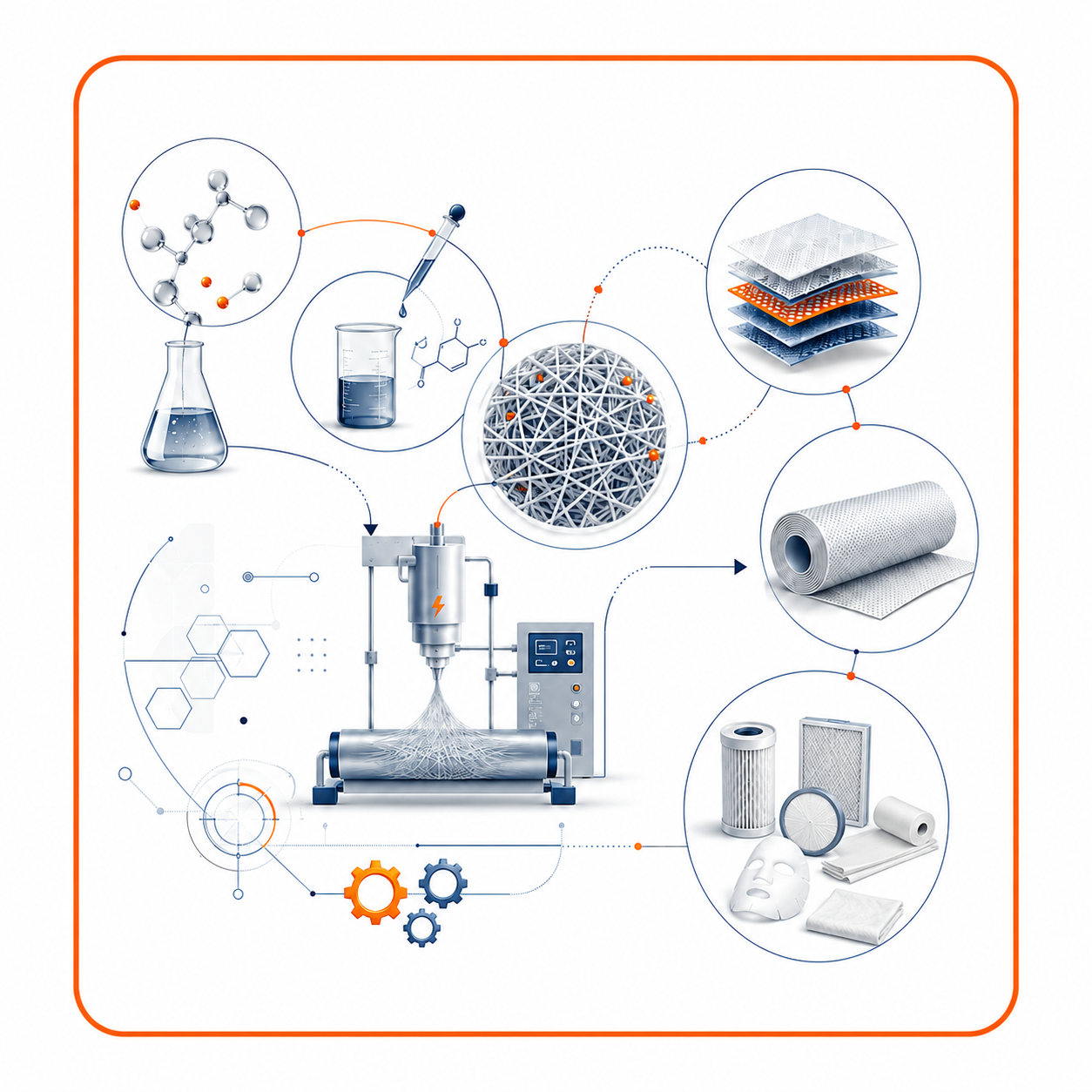
We bring together polymer chemistry, nanofiber production, electrospinning, melt electroblown spinning, substrate selection, lamination, surface treatment, microscopy, filtration testing, porometry, and industrial manufacturing.
This matters because nanofiber performance is never created by one step alone. A formulation decision affects fiber structure. Fiber structure affects pressure drop, permeability, adhesion, release behavior, and durability. Finishing can improve the material, or damage it if the system is not understood as a whole.
Our advantage is seeing the full system.
Surface-filtration structures, low-pressure-drop concepts, mechanical-efficiency media, pulse-cleanable composites, high-efficiency fine-fiber layers, functional finishes, and converting-ready roll goods.
Water-responsive or application-specific matrices, selected cosmetic-ingredient systems, controlled geometry, stability and packaging studies, private-label programs, and brand co-development.
Lightweight porous structures, breathable and barrier constructions, polypropylene-based concepts, laminate integration, calendering, and technical-textile validation.
OEM programs where conventional nonwovens, films, coatings, or membranes cannot achieve the required balance of surface function, weight, permeability, durability, or processability.
Our development programs are structured around a measurable problem and a clear industrial destination. We do not begin by asking, “What can this technology do?” We begin by asking, “What must the customer’s product do, under which conditions, at what scale, and how will success be verified?” This keeps research focused, reduces unnecessary iterations, and creates a practical route toward qualification and commercial supply.
The functional, technical, regulatory, converting, and commercial requirements of the intended product define the development space. Every experiment should answer a question that matters to the final application.
Materials are evaluated with industrial equipment, web width, line speed, substrate handling, lamination, finishing, yield, and quality-control requirements in mind. Scale-up risk is addressed early.
Chemistry, process engineering, manufacturing, laboratory, quality, and commercial teams contribute throughout the project. Decisions are made with a complete view of the product lifecycle.
Customer projects can be managed through defined confidentiality, sample-control, documentation, performance targets, stage gates, and ownership principles. The technical relationship is structured, not informal.
Successful co-development requires more than sending samples.
We work through a structured technical brief, defined responsibilities, protected confidentiality, clear test ownership, agreed acceptance criteria, and a path toward industrial qualification.
This keeps development focused on a real commercial outcome, not endless iteration. Customers gain a clearer view of performance, manufacturability, timing, supply, and launch readiness, while technical teams work directly with formulation, production, characterization, and application testing in one organization.
We use cookies to enhance your browsing experience, serve personalised ads or content, and analyse our traffic. By clicking "Accept All", you consent to our use of cookies.
Necessary
Required for basic site functionality.
Analytics
Helps us understand how the site is used.
Marketing
Used to deliver personalized ads.
Personalization
Remembers choices to personalize content.