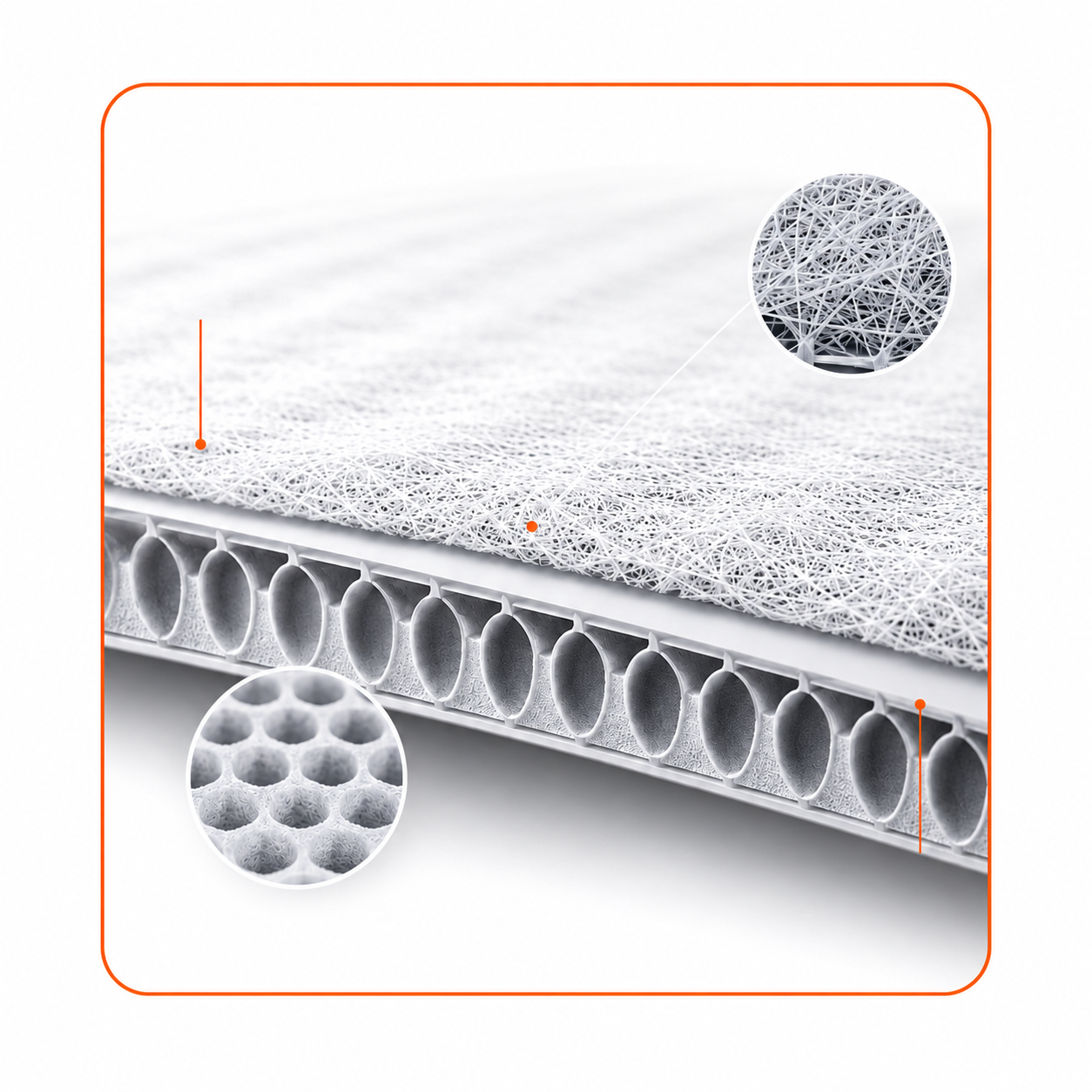
High Functional Surface
A fine-fiber web creates substantial surface area at low mass, supporting strong interaction with particles, air, liquids, coatings, or selected cosmetic ingredients.
A nanofiber layer may be only a few grams per square meter, yet its structure can determine how a filter captures particles, how a membrane transports vapor, how a surface interacts with liquids, or how a cosmetic matrix releases selected ingredients. At this scale, small variations matter. Nexture engineers the complete system, from polymer behavior and fiber formation to deposition, bonding, finishing, converting, and verification, to turn a delicate nano-scale web into a dependable industrial material.
Nanofibers create a very large functional surface within a very light layer. Their small diameters and interconnected pore structure allow engineers to influence particle capture, permeability, barrier behavior, surface interaction, liquid response, and mechanical integration without relying on a thick or heavy material. This is why nanofiber technology can create new performance combinations that are difficult to achieve with conventional fibers, films, or coatings.
The advantage is not automatic. A change in formulation influences fiber formation; fiber formation shapes deposition; deposition determines pore structure; and every downstream operation can either preserve or damage the result.
“Perfected” therefore means controlling the complete chain: designing the structure for a specific function, reproducing it across the industrial production width, and verifying that it remains consistent from batch to batch.
A fine-fiber web creates substantial surface area at low mass, supporting strong interaction with particles, air, liquids, coatings, or selected cosmetic ingredients.
In filtration, a nanofiber surface layer can capture smaller particles near the media surface, reducing the need for deep penetration into the supporting substrate.
Fiber diameter, deposition density, layer weight, and multilayer design can be adjusted to influence pore structure, air flow, vapor transport, liquid resistance, and barrier behavior.
Nanofibers can add a targeted function without the mass and bulk of a thick conventional layer, enabling thinner filter media, lighter membranes, and compact product designs.
The starting material must be engineered around the selected manufacturing route. Free-surface solution electrospinning requires control of polymer concentration, molecular behavior, viscosity, conductivity, surface tension, additives, temperature, and solution stability. Melt electroblown spinning requires control of polymer melt behavior, thermal stability, melt flow, and the conditions needed to form and attenuate fibers without a solution solvent.
Each route has its own connected process window. In free-surface solution electrospinning, electrical conditions, formulation behavior, environmental control, line speed, deposition, and collection determine the resulting structure. In melt electroblown spinning, melt temperature and flow, electrical conditions, controlled airflow, collection distance, cooling, and deposition behavior must work together. The objective is not one successful machine setting, but an operating window that remains stable during industrial production.
Diameter distribution, bead formation, fiber continuity, surface condition, and layer weight are monitored because they directly influence pore structure and application performance.
Collection geometry, web movement, tension, and process balance are controlled to maintain consistent coverage across an industrial production width rather than only at the center of a sample.
The nanofiber layer must be compatible with the substrate, lamination method, finishing route, converting stress, and final operating environment. A high-performing layer is only useful if it remains integrated.
Heat setting, calendering, corrugation, lamination, functional treatment, slitting, and packaging are selected to protect or enhance the structure. SEM and application-specific testing confirm the result.
Different applications require different polymer behavior. Current filtration programs include PA6, PP, and PVDF nanofiber systems, while broader development work can include water-soluble, bio-derived, and blended formulations for cosmetic or functional-material concepts. Material selection is based on the required morphology, chemistry, durability, temperature response, liquid interaction, processing route, and end-use environment.
Current filtration-media programs document fiber diameters in the 150–200 nm range, while the broader development platform can be configured across a wider range for different performance targets. The mean diameter is important, but distribution width, defects, continuity, and uniformity are equally critical. A narrow, stable distribution helps create predictable pore structure and repeatable performance.
A nanofiber layer is not designed in isolation. It may function as a surface barrier, a fine-particle capture layer, a transport layer, a carrier matrix, or part of a multilayer composite. We adjust layer weight, deposition density, support media, interlayers, scrims, laminates, and backing structures to create the right balance of function, strength, permeability, and convertibility.
The interface between the nanofiber web and the substrate often determines real-world durability. Bonding must be strong enough to survive winding, slitting, lamination, pleating, pulse cleaning, handling, or product use without destroying the fine structure. Adhesion is therefore developed as part of the material architecture, not treated as a final correction.
A beautiful SEM image is evidence of morphology, not proof of product performance. We therefore follow the nano-scale structure into the application.
For filtration media, the micrograph must ultimately connect to efficiency, pressure drop, dust loading, pore structure, and cleaning behavior. For membranes, it must connect to permeability, hydrostatic resistance, vapor transport, and mechanical stability. For cosmetic matrices, it must connect to formulation behavior, ingredient distribution, release or dissolution, stability, and packaging compatibility.
The test program changes with the application, but the principle does not: the structure visible under the microscope must explain the behavior of the finished product.
150–200 nm
documented fiber range for current filtration-media programs
1.6 m
industrial nanofiber production width
Every batch
SEM verification target for diameter distribution and uniformity
100% in-house
development, production, finishing, and core testing
We use cookies to enhance your browsing experience, serve personalised ads or content, and analyse our traffic. By clicking "Accept All", you consent to our use of cookies.
Necessary
Required for basic site functionality.
Analytics
Helps us understand how the site is used.
Marketing
Used to deliver personalized ads.
Personalization
Remembers choices to personalize content.