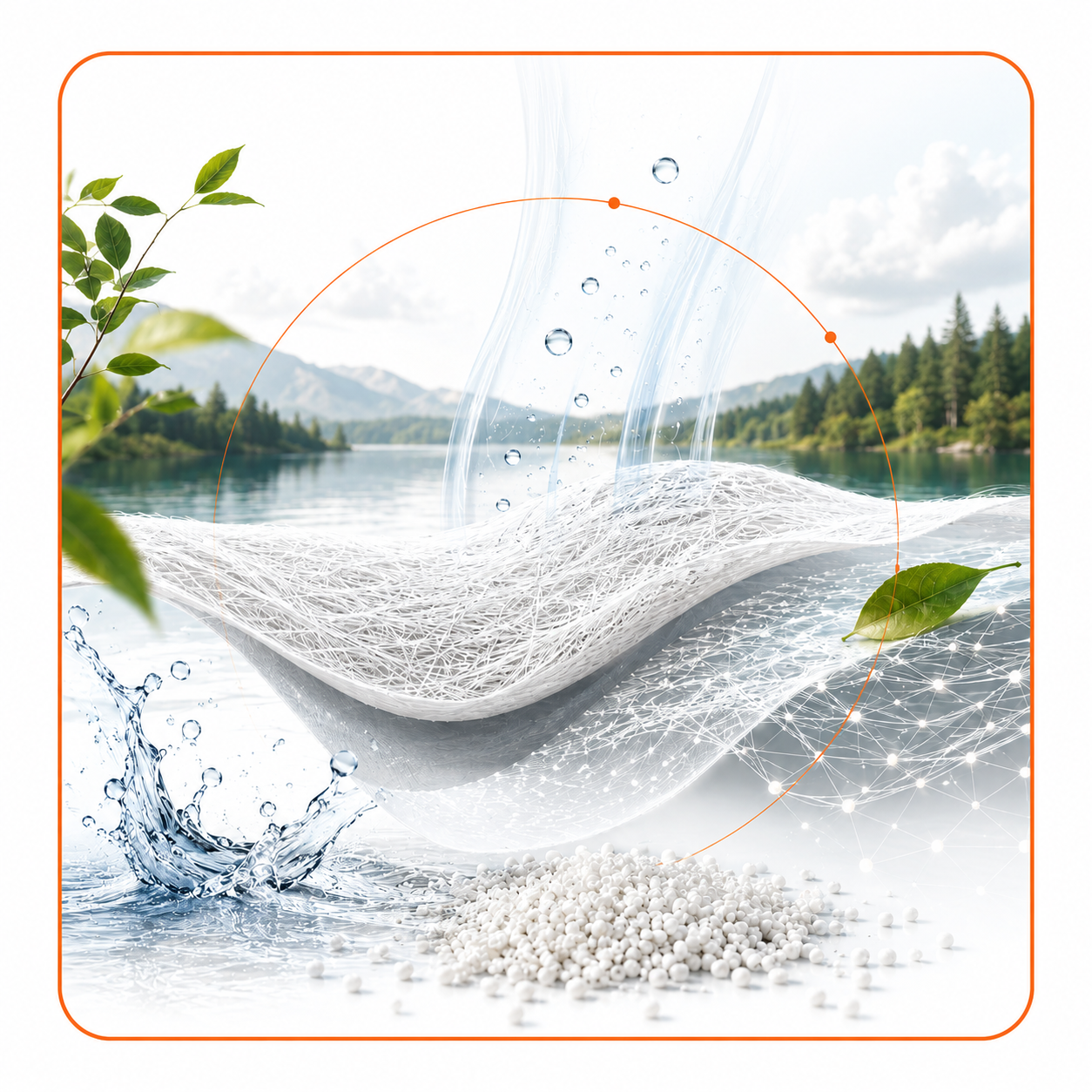
Use Less Material for the Required Function
Nanofiber layers can create high surface functionality at very low basis weight. We design the layer around the performance required rather than adding unnecessary thickness.
Sustainability is not a side message for Nexture. It is part of why nanofiber technology matters. For us, sustainability means using advanced materials with respect for both industrial performance and the natural resources behind every product. Nanofiber layers can create strong function at very low material weight: filtration, barrier behavior, permeability, surface interaction, release performance, and durability. This allows us to design materials at the right scale, using structure instead of bulk, precision instead of excess, and performance instead of unnecessary material. Our approach connects material efficiency, responsible process selection, durable product design, integrated manufacturing, and application-specific validation. The goal is to create materials that perform better, last longer, use resources intelligently, and support a more responsible relationship between industry and nature.
Nanofiber technology changes how material performance can be created. Instead of relying only on thickness or mass, a nano-scale functional layer can strongly influence how a product captures particles, moves air, transports vapor, resists liquid, interacts with a surface, or performs over time.
That is the sustainability opportunity: less material, higher influence.
This is where nanofiber technology becomes especially meaningful: it allows performance to come from structure and precision rather than simply consuming more material. But sustainability must be treated honestly. The polymer, production route, energy use, finishing chemistry, product lifetime, operating performance, and end-of-life pathway all matter. That is why Nexture evaluates sustainability as a complete material journey, from first formulation to final application.
Nanofiber layers can create high surface functionality at very low basis weight. We design the layer around the performance required rather than adding unnecessary thickness.
Integrated spinning, lamination, slitting, finishing, converting, and testing reduce unnecessary external transfers, handling, packaging, waiting time, and rework.
Stable efficiency, strong nanofiber adhesion, durable surface treatments, and controlled finishing can reduce premature replacement and material waste.
A responsible material must fit the product it becomes. We evaluate the final application, operating conditions, converting process, service life, and end-of-life expectations before defining the material structure. This helps avoid over-engineering and supports solutions designed at the right technical scale.
Nano-scale structures can provide filtration, barrier, transport, or surface functionality with minimal material weight and reduced product bulk.
Core development, nanofiber production, lamination, slitting, finishing, converting, and testing are coordinated within one integrated facility.
Our melt electroblown spinning route forms nanofibers directly from molten polymer, without solution solvents during the fiber-forming stage. This creates a cleaner process pathway for technically suitable polymers while keeping the full product honestly evaluated across energy use, material choice, finishing, performance, and end-of-life.
Polypropylene nanofibers can be developed with compatible PP-based support structures to explore simpler material architectures. This does not mean every finished product is automatically recyclable. It means end-of-life thinking can enter the material design from the beginning.
Low and stable pressure drop can reduce the fan energy required to move air through a filtration system during its operating life.
SEM verification, process monitoring, testing, and controlled production help reduce variation, rejected material, unnecessary rework, and avoidable waste.
The environmental value of a technical material is often shaped during use.
A filter that maintains lower pressure drop can reduce energy demand. A surface that releases dust more effectively can support cleaner operation and longer service intervals. A durable nanofiber layer can reduce premature replacement. A lightweight membrane can deliver function without unnecessary mass.
For Nexture, sustainability and performance are not separate goals. The most responsible solution is often the one that achieves the required function with the right amount of material, stable performance, and a longer useful life.
Responsible material design is not only about choosing a polymer or a process.
It is about understanding how chemistry, fiber formation, substrate, finishing, converting, use conditions, and end-of-life expectations work together. Nexture evaluates these choices through the final product and its real application.
Free-surface solution electrospinning provides broad material and formulation flexibility but requires responsible solvent selection, handling, process control, and waste management. Melt electroblown spinning forms fibers directly from molten polymer and eliminates solution solvents from the fiber-forming stage.
A recyclable polymer does not automatically make the finished product recyclable. We evaluate the complete construction, including the nanofiber layer, substrate, bonding method, finish, reinforcement, and the recycling systems available in the target market.
A product that fails early creates additional material consumption, transport, maintenance, downtime, and waste. Adhesion, mechanical stability, cleaning behavior, humidity resistance, and performance consistency are therefore sustainability factors as well as quality factors.
We support specific, evidence-based sustainability statements and avoid broad claims that cannot be proven.
Terms such as “solvent-free,” “recyclable,” “energy-saving,” or “longer-lasting” should always be connected to a defined process, material structure, test condition, or application.
Our sustainability direction is to increase the functional influence of every material we design.
We aim to expand solvent-free melt electroblown spinning where technically suitable, improve material efficiency across both nanofiber routes, reduce avoidable waste and rework, develop more compatible polymer structures, strengthen application-based performance data, and involve end-of-life thinking earlier in product development.
For Nexture, sustainability is part of how we define materials, processes, applications, and long-term value.
Solvent-free pathway
melt electroblown spinning without solution solvents during nanofiber formation
PP-based concepts
compatible polymer structures designed with end-of-life thinking from the start
Less material, higher influence
nano-scale structures designed to create strong function with carefully measured material use
One integrated site
development, manufacturing, finishing, converting, and testing within one facility
We use cookies to enhance your browsing experience, serve personalised ads or content, and analyse our traffic. By clicking "Accept All", you consent to our use of cookies.
Necessary
Required for basic site functionality.
Analytics
Helps us understand how the site is used.
Marketing
Used to deliver personalized ads.
Personalization
Remembers choices to personalize content.